
The index could be vulnerable to a bigger fall given the present market dynamics.

Shares of Indian Railway Catering and Tourism Corporation (IRCTC) hit a new high of Rs 4,512 after surging 8 per cent on the BSE in Wednesday's intra-day trade, on the back of heavy volumes, ahead of 1:5 stock split. The trading volumes on the counter more-than-doubled today, with a combined 7.02 million equity shares having changed hands on the NSE and BSE till 11:19 am. In the past one week, the stock of the state-owned travel support services company has rallied 20 per cent after the company on September 29, 2021, said that it has fixed October 29, 2021 as the record date, to ascertain the name of shareholders entitled for subdivision/split of equity shares of Rs 10 each into five (5) equity shares of face value of Rs 2 each.

Quarterly earnings from corporates, global trends, and trading activity of foreign investors will guide market sentiment this week, analysts said, adding that benchmark indices may face volatile trends. "The upcoming release of Q2 results will be closely watched, providing insights into corporate performance. "Meanwhile, the escalating tensions between Israel and Iran introduce a significant geopolitical risk, potentially leading to increased oil prices and market volatility.

Equity benchmark Sensex on Thursday plunged about 965 points to crash below the 80,000 level due to heavy selling in global equities after the US Federal Reserve signalled fewer rate cuts next year. Besides, deep losses in consumer durables, banking and IT stocks amid foreign fund outflows added to the gloom, analysts said.

After lagging behind benchmarks and broader indices over the past five years, real estate investment trusts (Reits) have outperformed them since the start of 2024. The four listed Reits have posted an average return of 16 per cent year-to-date, compared to 9.9 per cent for the S&P BSE Sensex and 11 per cent for the National Stock Exchange Nifty.

Major Indian carmakers are preparing for sluggish domestic PV sales growth of just 1-2 per cent in FY26.

As temperatures soar across the country, amid searing heat wave, analysts see power demand hitting fresh record highs this year. The time, therefore, may be opportune to add related stocks on dips as higher demand boosts earnings visibility, they said. On April 18, India's electricity demand touched a new high of 216 gigawatts.

Among the 11 equity sub-categories, thematic funds received the highest net inflows at Rs 9,017 crore, followed by smallcap funds at Rs 5,721 crore and flexicap funds at Rs 5,698 crore.

The stock market's momentum will be guided by the ongoing quarterly earnings season, with Reliance Industries, HUL and Bajaj Finance among those scheduled to announce their results this week, analysts said. Focus would also remain on the COVID situation, global stock markets, investment pattern of foreign institutional investors (FIIs), rupee-dollar trend and Brent crude, they added. "The earnings season would gain pace this week and participants will be closely eyeing the results of some of the top names like Reliance, Ultratech Cement, Bajaj Auto, JSW Steel, Bajaj Finance, Asian Paints, Hindustan Unilever among others. "Before that, markets will first react to the earnings of two heavyweights -- HCL Technologies and HDFC Bank in early trade on Monday," said Ajit Mishra, VP Research, Religare Broking.
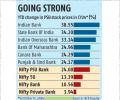
Stock Market News today, PSU banks: The year 2024 was a roller-coaster ride for Indian stock markets, marked by volatility driven by the Lok Sabha elections, Union Budget 2024, a slowdown in corporate earnings, and sticky inflation. Geopolitical tensions - particularly between Israel and Iran in West Asia - along with various stimulus announcements by China and yen carry trade rocked the equity markets throughout the year.

The dream-run in railway stocks may soon run out of steam, caution analysts. The rally, which has lasted nearly a year, may meet time-wise correction post the Union Budget announcements as investors begin scalping profits. "There is going to be a build-up in expectations for the sector from the Union Budget, which is still two-odd months away.

The sharp rally in the markets thus far in fiscal 2023-24 (FY24) has left analysts struggling to find investment-worthy themes. The S&P BSE Sensex has surged nearly 7 per cent thus far in FY24 and hit a fresh 52-week high of 63,601.71 levels on June 22, mostly led by foreign institutional (FII) flows. "The Indian market has seen a broad rally in the past few months but headline indices have seen more modest performance. "We are not very clear about the reasons for the rally and the divergent performance and struggle to find ideas in the consumption, investment and outsourcing sectors after the sharp run-up in several of our favored sectors and stocks in the past two months," wrote Sanjeev Prasad, co-head, Kotak Institutional Equities, in a recent co-authored note with Anindya Bhowmik and Sunita Baldawa.

Management commentary on demand environment, and forward guidance will be in focus when Indian IT services players declare their September quarter results for financial year 2024-25 (Q2FY25). The industry is exepected to have continued on the path of recovery in Q2, similar to the preceding quarter, rather than sprint towards growth. The top four firms likely grew between 0 per cent and 4 per cent year-on-year (Y-o-Y), according to consensus estimates.

The Nifty IT index, data shows, has outperformed the markets in each of the last four election years post the result. announcement.

The Reserve Bank of India's (RBI's) interest rate decision, West Asia conflict and trading activity of foreign investors are the key factors that will dictate investors' sentiment in the market this week, analysts said. Moreover, quarterly earnings from IT bellwether TCS, domestic macroeconomic data and movement in global oil benchmark Brent crude would also guide trends in the market. Worsening tensions in the Middle East and foreign fund outflows were the major culprits behind the equity markets sharp fall last week.

Markets to track inflation data, global trends, FII trading this week: Analysts New Delhi, Dec 8 (PTI) Investors' sentiments will be guided by a host of domestic and global macroeconomic data announcements this week, along with the trading activity of foreign investors and trends in world stocks, analysts said. Besides, the rupee-dollar trend and movement of global oil benchmark Brent crude will also be crucial in dictating terms in the market, experts added. "The domestic stock market is likely to be shaped by a mix of global cues, domestic economic indicators, and the flow of investments from foreign and domestic institutional investors. Key factors like the rupee's exchange rate and crude oil prices will play a critical role in determining market trends. "Globally, geopolitical tensions, particularly the ongoing Russia-Ukraine conflict, continue to pose challenges. However, recent declines in the dollar index and US bond yields have created a more favourable environment for emerging markets like India," Pravesh Gour, Senior Technical Analyst, Swastika Investmart Ltd, said. On the economic front, significant macroeconomic releases, including retail inflation and industrial production data from India as well as US core CPI, are expected to influence overall market sentiment, Gour added. Last week, the BSE benchmark jumped 1,906.33 points or 2.38 per cent, and the NSE Nifty climbed 546.7 points or 2.26 per cent. "FIIs turning buyers in early December, in a total reversal of their sustained selling strategy during the last two months, has altered the market sentiments. The change in FII (Foreign Institutional Investors) strategy is getting reflected in stock price movements, particularly in large-cap banking stocks in which FIIs have been sellers," VK Vijayakumar, Chief Investment Strategist, Geojit Financial Services, said. The release of US CPI inflation data will give some insights into the Fed's December meeting, an expert said. "The markets' attention is expected to turn towards macroeconomic indicators like IIP and CPI inflation. Additionally, the trend of FII inflows, following their recent buying spree, will remain a key focal point for market participants," Ajit Mishra - SVP, Research, Religare Broking Ltd, said. Siddhartha Khemka, Head - Research, Wealth Management, Motilal Oswal Financial Services Ltd, said this week will see significant economic data releases, including GDP numbers from Japan and the UK, along with China's CPI and India's CPI.

Global factors and FII activity will dictate trends in domestic equity markets this week while assembly poll results of Maharashtra and Jharkhand may impact stocks on Monday, say analysts. Stock markets witnessed a spirited recovery on Friday with benchmark Sensex and Nifty notching the best single-day gains in more than five months and offering relief after weeks of correction.

The trigger for international gold prices rising to $3,000 per ounce was Germany's upcoming heavy government borrowing.

Industry experts believe that this deal will positively impact the Indian film industry, which is struggling with fewer movie releases.

The stock of Crompton Greaves Consumer Electricals has shed about 12 per cent since the start of the month due to a muted near-term outlook. Demand slowdown across segments and pre-buying in cooling products in the June quarter are expected to weigh on revenues going ahead. In addition to pre-buying in the preceding quarter, demand conditions are soft on account of lower consumer spending due to inflationary conditions, weakness in rural demand and the fact that Q2 remains a soft quarter after a strong summer.

'As the markets are expected to remain jittery in the near term, we advise investors to use this opportunity to enter quality largecaps from a long-term perspective.'

Macroeconomic data announcements, global trends and trading activity of foreign investors would be the major driving factors for the equity markets this week, according to analysts.

Hotel companies, which have experienced substantial share price gains in the past six months, are not only expected to post robust revenue growth in the seasonally weak July-September quarter (second quarter, or Q2) of 2023-24 (FY24), with the trend continuing in the second half (H2) of FY24, but according to some analysts, they will also benefit from a structural uptrend in progress. To begin with, larger players in the listed hotel sector are expected to report strong growth in Q2 compared to the year-ago quarter. Led by higher demand from the business segment, the sector is expected to achieve a growth rate of 15-30 per cent.

'A 10 to 15 per cent allocation to gold in portfolios reduces risk without compromising on potential returns.'

If Hindenburg or its partner do not join the investigation, then Sebi may pass an ex-parte order against it, which may be enforced as a foreign award in US courts.

Arbitrage funds, the new favourite of individual investors, delivered their best performance in nearly a decade in 2024. On average, the schemes delivered 8 per cent return last year, the highest since 2016, according to data from Value Research. The returns were supported by positive equity market sentiments, surge in open interest in stock futures, high interest rate, among other factors, analysts said.

'We expect market consolidation and recommend buying during market dips.'

Traction for its specialty portfolio, a strong showing in the domestic market, and better regulatory compliance are positives for the country's largest pharmaceutical (pharma) company, Sun Pharmaceutical Industries. Given the triggers, some brokerages have increased their earnings per share estimates and target price for 2024-25 (FY25). This should sustain the momentum for the stock, which has been one of the major pharma gainers in 2023-24 (FY24), rising 57 per cent. It is currently trading at Rs 1,547 per share.

The outcome of the Union Budget, quarterly earnings from corporates and global trends are the major factors to drive stock market sentiments this week, analysts said. Besides, the trading activity of foreign investors, the rupee-dollar trend and the movement of global oil benchmark Brent crude are also crucial aspects to watch out for.

Among the 30 Sensex companies, Larsen & Toubro, Power Grid, NTPC, State Bank of India, Reliance Industries and HDFC Bank were the biggest laggards. Sun Pharma and Nestle were the only gainers.

10 largecaps stocks which stand to gain from the Budget.

The Reserve Bank of India's (RBI's) record surplus transfer to the government has raised hopes among bond traders that the government might reduce its gross borrowing for the current financial year (2024-25/FY25) by up to Rs 1 trillion. The RBI approved a dividend of Rs 2.11 trillion for the central government for 2023-24, marking an increase of roughly 141 per cent from 2022-23 (FY23). In addition, the contingency risk buffer has been raised to 6.5 per cent from the previous 6 per cent.

Global trends, trading activity of foreign investors and domestic macroeconomic data announcements would dictate terms in the equity market in a holiday-shortened week ahead, analysts said. Equity markets would remain closed on Wednesday for Gandhi Jayanti. "Looking ahead, it will be interesting to monitor Foreign Institutional Investors (FIIs) and their flow into India.


Apple's ambitious strategy to expand iPhone exports, shift more production from China to India at a faster pace, and grow its domestic market hits a Trump-sized roadblock.

'The strategic direction of the relationship will not be affected. But the perception has been affected.'

'We have to retain some fiscal headroom without compromising on the promised fiscal consolidation roadmap.'

All sectoral indices ended lower. BSE Telecommunication tanked 2.18 per cent, metal (1.77 per cent), auto (1.70 per cent), energy (1.64 per cent), oil & gas (1.59 per cent), commodities (1.39 per cent) and financial services (1.37 per cent) were the major laggards.

The recent price correction in broader markets has hit cement companies hard. So far in the current month, smallcap firms like Visaka Industries, Andhra Cements NCL Industries, Sahyadri Industries, and KCP have lost 19.7 per cent, 14.3 per cent, 13.8 per cent, 13.5 per cent, and 11.5 per cent, respectively. On the contrary, largecap companies, while registering losses for the month, have seen a softer blow.

Similar discounts compared to online led to a spike in demand for offline, where customers can get a more personal and hands-on product experience.
